 Dr Julia Martins
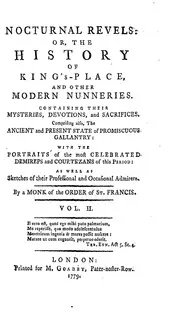
Nothing was more eagerly sought after than the Pleasure of deflowering a Virgin; it was esteemed the choicest Rarity in the whole Trade of Love, and paid for accordingly.
This passage comes from the 1779 book
Part 1 – Maidenheads for sale
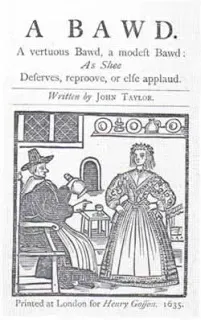
In 1635, the pamphleteer John Taylor published a short satire about prostitution called A Bawd. (A bawd is a woman in charge of a brothel.) The bawd:
can make one Maidenhead [a hymen] serve three or four hundred times, and take as much money as if it were new, and never touched before. If there be no blood, she hath a trick to make it, and so she deceives young gentlemen finely.
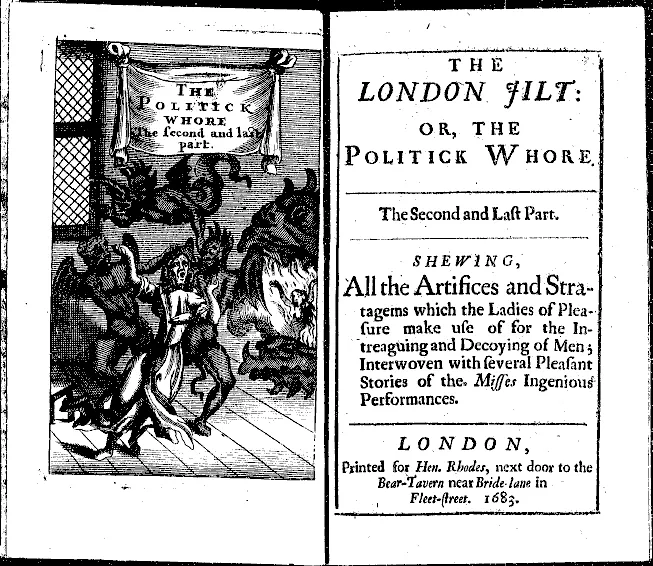
Of course, if you were a madam, finding a virgin wasn’t easy – most girls willing to do sex work would have some experience already, presumably. But, if they could be passed as virgins to deceive patrons, that would be enough. This text reinforced stereotypes about women being deceitful, accusing the brothel keepers of selling sex workers’ virginity again and again. Of course, this is satire, and so it’s an exaggeration for comic effect, but the idea was that virginity could be staged, faked, and performed, highlighting that it wasn’t simply a personal attribute. Virginity was a commodity – one that fetched a higher price if you were a sex worker in 17th and 18th-century Britain. In a 1683 story, called “The London Jilt, or the Politick Whore”, Cornelia talks about losing her virginity several times, “after the manner of Italy” – possibly, using a solution with chemicals such as red lead or alum, which would be toxic. But why?
For there is nothing more advantageous to a Woman that drives this Trade, than to appear to be a Novice in it: Nay, though she have been a Whore these ten years, yet she must still pretend to be young at it, and seem as if she had scarce seen Man before. For there are a great many Fools that will give more for the supposed Pleasure of enjoying a Woman the first time, than they will for the true Pleasure of enjoying her afterwards.
— The London Jilt (1683)
The
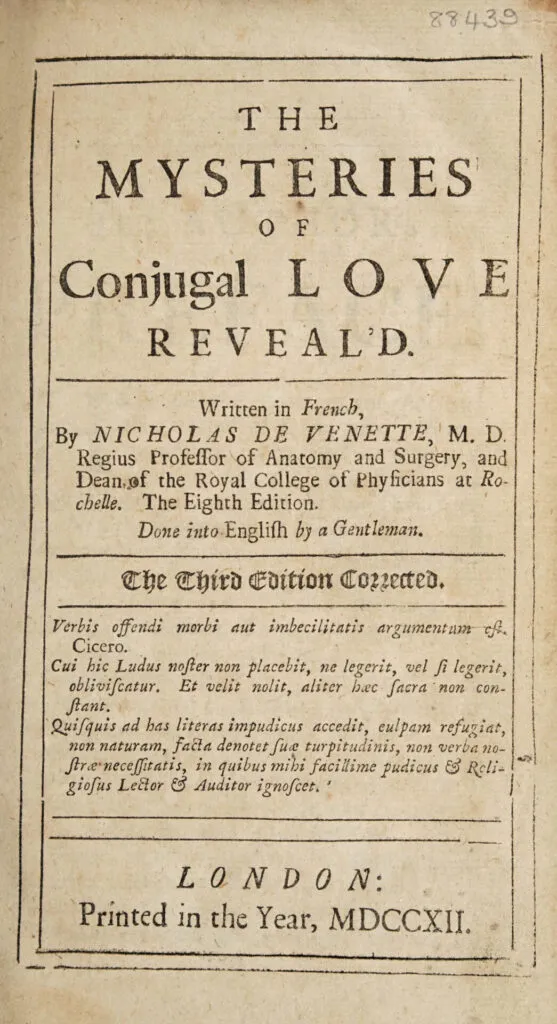
Virginity, then, was not so much a stable biological fact but a cultural performance. Some doctors insisted it could be detected in the body; others denied that any such signs were reliable. In a popular 17th-century French medical text, translated into English as
The first time, the Bride is commonly in Pain, by reason of the Narrowness of the Passage, and the Opposition of the Membrane which closes it; from whence there proceeds a little Blood, which is the certain Sign of Virginity.
— Venette, Mysteries of Conjugal Love Reveal’d (1712 ed.)
Still, the ancients hadn’t really written about the hymen much – it isn’t until the late 15th century that it starts becoming associated with virginity. But not everyone agreed there was such a thing as a hymen. The French royal surgeon
Yet cheap print – erotic narratives and medical manuals, for instance – circulated far more widely than this scepticism. And, regardless of there being a hymen, blood would be expected anyway. Physicians, poets, and bawds, satirical pamphlets and medical treatises, all converged on the same point: virgins bleed.
The commercial value of maidenheads rested on a simple expectation: first intercourse should hurt, and it should draw blood. This belief was repeated endlessly in medical manuals, household guides, and sex instruction books. One of the most famous was
The Masterpiece lists the “signs of virginity,” including pain at penetration, tightness of the passage, and above all, bleeding. The work’s immense popularity (it was sold by street vendors, along with cheap ballads and pornography) ensured that such ideas reached many people.
There’s another reason why virgins were in such high demand, though. And that’s to do with venereal disease, especially
Part 2 – “Restoring” Virginity
As I mentioned in my other text, there was a long tradition of recipes for “restoring” virginity, dating back to 12th-century texts. These formulas aimed to “tighten” everything so that men would believe a woman to be a virgin, and they would also give the illusion of blood.
A pseudo-Aristotelian text, “
To make an artificial maidenhead. Q. How may it be possible to recover a lost Virginity, or make one pass for a Maid that has known Man? A. The Virginity once lost can never be said properly to be restored, yet an artificial one aping the true one may be obtained, and pass muster very well, by strengthening the Genitals, and retriving the Tone, which must be affected by Baths and Fomentations prepared of Astringents, such as the Root of the greater Comfrey, Plantane, Ladies Mantle, robe of Acacia, and Alum, and this Fomentation decocted in fair Water, may be apply’d with a sponge, or injected with a syringe.
Some people even spoke of fake hymens, artificial membranes being sold by street vendors. But behaviour played a key role here, too. In another, earlier, medieval text, De secretis mulierum:
A virgin is known because her voice is clear, she blushes quickly, and above all because her genital member is straight and narrow, not relaxed. In intercourse, if she is a virgin, there is a flow of blood.
— Pseudo-Albertus, De secretis mulierum, trans. Lemay, 1992
By the seventeenth century, this knowledge was trickling into vernacular English manuals like
In any case, these books were incredibly popular, because they merged pseudoscience with the titillation of sexual secrets. For a society obsessed with maidenheads, these books offered both reassurance (that signs of virginity were knowable) and possibility (that they could be reproduced).
In “The Mysteries of Conjugal Love Reveal’d”, the author is surprisingly ok with wives fooling their husbands. He writes:
Might it not be allowable for a Woman, who has past some years of her Life in unlawful Pleasures, to secure her Husband’s good Opinion on the Wedding Night by taking up some Blood (which she treasured up before) and putting it into the Privities? May it not be allowable, I say, for the Preservation of Peace in her Family, to take all the pains imaginable to be thought a discreet Woman by her Husband?
There’s a question.The 16th-century French doctor Severin Pineau also wrote that wives used astringent formulas to please their husbands with their “tightness”, but sex workers allegedly did so to con men into thinking they were virgins. For a sex worker or a madam, all they needed to do was combine these formulas with a bit of theatre to fulfil their clients’ expectations. Before intercourse, an astringent using something like alum and egg whites might be used to give the sensation of tightness, along with plants like myrtle, lady’s mantle, or plantain. The woman would act modestly and be reluctant to heighten the illusion of innocence. In the London Jilt, Cornelia describes this:
I made a great deal of resistance, and seemed as if I had been ravished against my Will; for in that Lay the whole Mystery of my Art, to make my Lovers believe I was unwilling, when I desired it more than they did. Thus by feigning Reluctance, I made them the more eager, and when I had once granted what they desired, I never failed to draw Money from them the more plentifully.
— The London Jilt (1683)
Cornelia is very resourceful in this book. Now, some of these recipes would provoke spotting, but others were more dramatic. The best example here is probably
Of course, this is not a first-hand account by a sex worker. But 18th-century texts like these were relying on a well-known trope, that women had plenty of tricks with which to fool men. And such narratives titillated readers while teaching both clients and sex workers what to expect.
Part 3 – Blood and the Libertines
Why was blood so desirable?
So, the answer lies perhaps in libertine culture. The
In Britain, poets and playwrights from Abraham Cowley to
In
The defloration of virgins was central to the libertine male ideal and it remained so for over a century. In short, libertine culture created demand, and the brothel trade supplied it. In a story called “The Devil and the Strumpet: Or, the Old Bawd Tormented” (1700), there is a madam, Jane, who is visited by the devil, as punishment for her lewd behaviour – but also, for exploring other sex workers. It was by selling their maidenheads that she could open her own brothel, after all. So, there’s a moral message here: bawds corrupt girls and fool clients.
Again, we shouldn’t think this was a widespread practice, but the very premise of this pamphlet reveals that such deceptions were assumed to be real. It would hardly make sense to condemn a bawd for tricks no one believed possible. And, while we could easily see these tricks as the sex workers playing the game and trying to survive in a patriarchal world, there’s also the idea that women could explore other, younger women, too. And that’s illustrated really well by Harlots, with a madam, Maggie Wells, selling her daughters’ virginity to the highest bidder.
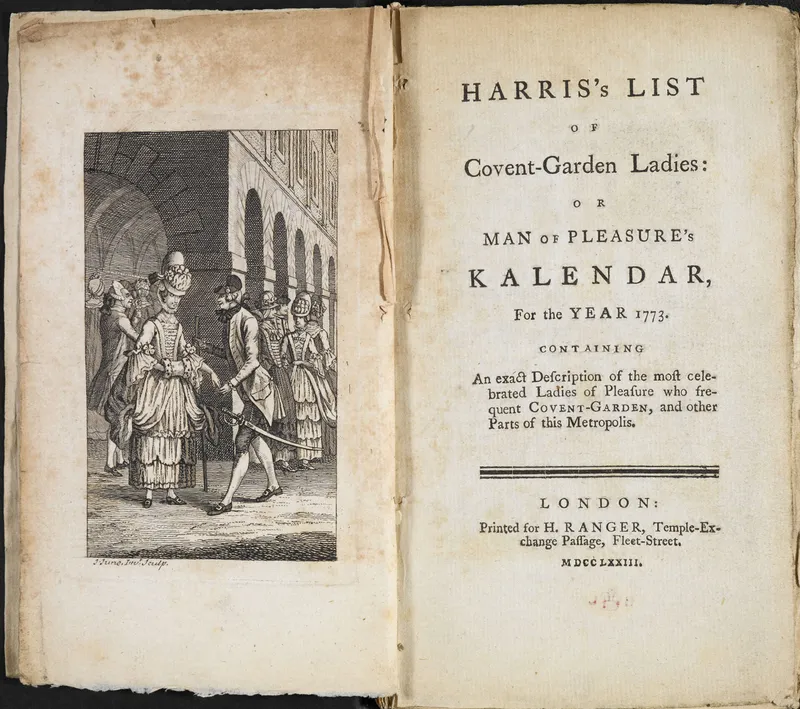
In any case, 18th-century people were fascinated by the world of brothels. Harris’s List of Covent Garden Ladies, which has inspired much of this TV show, was published from around 1760 to 1790, and it was essentially a list of sex workers in London, describing their specialities, hobbies, and physical appearances. Another publication, like the Nocturnal Revels I started the text with, also claimed to lift the veil on London’s brothels. There’s a lot of fiction here, but they give us a glimpse into the attitudes towards prostitution at the time. In one anecdote, for instance, the madam Mother Douglas is praised for her ability to supply virgins:
Her skill was such, that a Maidenhead was always ready to be produced at the shortest Notice; and many a Nobleman has paid a hundred Guineas for a Girl, who was, to his thinking, untouched, though she had been in keeping for Months before.
— Nocturnal Revels (1779)
It is said that
“Her eyes are grey, her hair is brown, and countenance as open as her heart; for, notwithstanding the varieties she has seen in life, she has not learned to deceive.” So, her honesty is highlighted, at the same time that these narratives about sex workers’ tricks are everywhere – and they mentioned how
I just love the irony of libertine culture. Clients wanted virgins; bawds supplied them. The fact that they could do so repeatedly only underscores that virginity was a marketable fiction.
Final Thoughts
Virginity was commodified in 17th and 18th-century Britain: bawds profited, clients boasted, and authors sensationalised. Blood became currency, maidenheads a marketable good, and the performance of defloration a profitable spectacle. Why does this all matter? It might be tempting to treat all this as a quaint curiosity of
References
Aristotle’s Masterpiece (London, 1684).
Aristotle’s New Book of Problems (c. 1720).
Thomas Bartholin, Anatomicae Institutiones Corporis Humani (Copenhagen, 1641).
Aphra Behn, The Rover (1677).
Iwan Bloch, The Sexual Life of Our Time in its Relations to Modern Civilization (1909).
John Cleland, Memoirs of a Woman of Pleasure (1749).
Nicholas Culpeper, A Directory for Midwives (London, 1651).
Mary Fissell, “Hairy Women and Naked Truths: Gender and the Politics of Knowledge in Aristotle’s Masterpiece.” William and Mary Quarterly 60.1 (2003): 43–74.
Monica Green, The Trotula: An English Translation of the Medieval Compendium of Women’s Medicine (2001).
Katherine Harvey, The Fires of Lust: Sex in the Middle Ages (2021).
Helen King, Helen. Immaculate Forms: Uncovering the History of Women’s Bodies (2024).
Kate Lister, A Curious History of Sex (2021).
Ambroise Paré, The Workes of that Famous Chirurgion Ambrose Parey (London, 1634).
Julie Peakman, Lascivious Bodies: A Sexual History of the Eighteenth Century. London: Atlantic Books (2004).
_____, Whore Biographies, 1700–1825 (2006).
_____, Cultural, Scientific and Religious Influences in Eighteenth-Century Erotica, c.1680–c.1830. PhD dissertation, University College London, 2001.
Sara Read, “‘Gushing Out Blood’: Defloration and Menstruation in Memoirs of a Woman of Pleasure.” Journal of Medical Humanities 39.2 (2018): 167–184.
Jean Riolan, Anthropographia (Paris, 1618).
Hallie Rubenhold, The Covent Garden Ladies (2020).
John Wilmot, Earl of Rochester, Poems on Several Occasions (1675).
John Taylor, A Bawd (London, 1635).
Nicolas Venette, The Mysteries of Conjugal Love Reveal’d (London, 1712).
William Wycherley, The Country Wife (1675).
De secretis mulierum (Pseudo-Albertus Magnus), trans. Helen Rodnite Lemay. Women’s Secrets: A Translation of Pseudo-Albertus Magnus’s De secretis mulierum with Commentaries (1992).
The London Jilt; or, The Politick Whore (London, 1683).
Nocturnal Revels: Or, The History of King’s Place and Other Modern Nunneries (London, 1779).
The Devil and the Strumpet: Or, the Old Bawd Tormented (c. 1700).